
The Strange Exhaustion Of Modern Life
RECENT REFLECTIONS
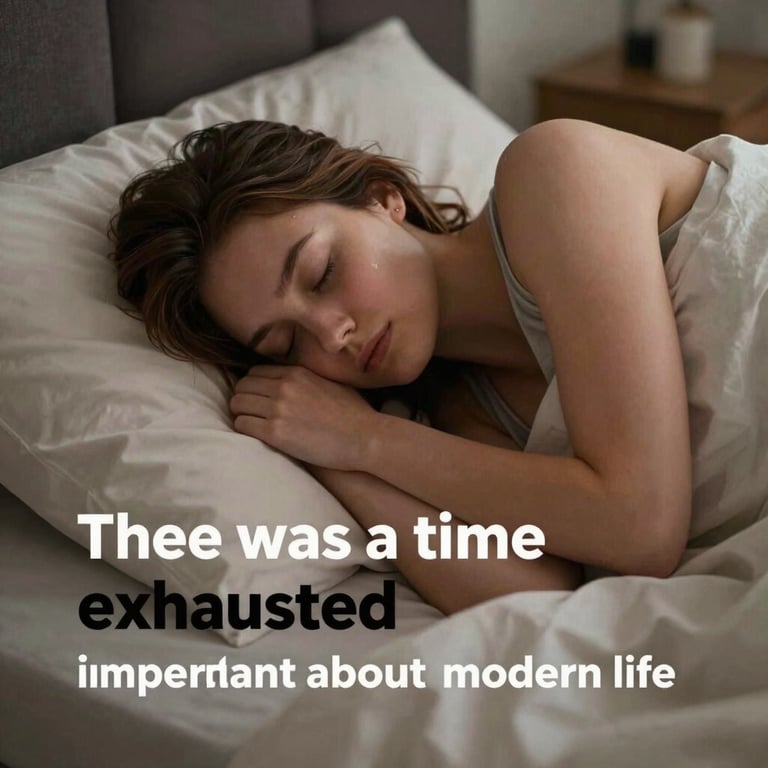
here was a time when exhaustion came mostly from physical effort. People worked in fields, walked long distances, carried weight, built homes with their hands, and slept deeply at night because the body had genuinely earned rest.
Today, many people are exhausted without physically doing very much at all. That change says something important about modern life.
The modern human being is not merely physically tired. He is mentally crowded, emotionally overstimulated, digitally surrounded, socially performative, and psychologically restless. The body may be sitting quietly in a chair, but the mind is running continuously.
Perhaps this is why silence has become uncomfortable for many people.
A few minutes without a phone, conversation, music, notifications, or distraction can suddenly feel unbearable. Something inside constantly demands stimulation. The mind has become conditioned to movement even when no movement is necessary.
Modern systems encourage this condition.
Everything competes for attention:
screens,
advertisements,
opinions,
outrage,
entertainment,
endless information,
endless comparison.
Human attention has quietly become an economic resource.
The more distracted people remain, the more profitable many systems become.
As a result, many people rarely experience mental stillness anymore. Even moments that once belonged to quiet reflection are now occupied by scrolling, reacting, consuming, and performing.
Ironically, despite unprecedented technological convenience, many people seem internally more fatigued than previous generations.
Convenience has reduced physical strain but increased psychological noise.
The mind was perhaps never designed to process the sheer volume of emotional and informational stimulation now entering it daily.
There is also another subtle exhaustion that modern life produces — the exhaustion of maintaining identity.
People increasingly feel compelled to constantly project:
success,
happiness,
opinions,
relevance,
productivity,
attractiveness,
importance.
A great deal of energy is spent not merely living life, but appearing to live it correctly.
Over time, this creates a quiet inner fatigue.
Not because people are weak, but because continuous self-presentation is psychologically expensive.
Somewhere along the way, many humans stopped simply experiencing life and started managing impressions of life.
The tragedy is that this condition slowly begins to feel normal.
People adapt to noise the same way city dwellers adapt to traffic sounds. What would once have felt mentally overcrowded eventually becomes ordinary daily existence.
But occasionally, a person steps away from the movement:
into nature,
into solitude,
into silence,
into deep conversation,
or into genuine reflection.
And suddenly something becomes visible.
One realizes how loud modern life had quietly become.
Perhaps this is why some of the most meaningful moments in life still arrive without spectacle:
sitting quietly after everyone has left,
watching rain without urgency,
walking without headphones,
speaking honestly with someone trusted,
reading slowly,
or simply remaining unavailable to the world for a while.
These moments do not increase productivity.
They do not build status.
They do not generate visibility.
But they restore something essential that constant stimulation slowly erodes.
Modern life offers extraordinary opportunities, comforts, and access to knowledge. It would be dishonest to deny that.
Yet somewhere within all this progress, many people have also lost the ability to remain peacefully alone with their own thoughts.
And perhaps that is one of the quiet costs of modern living.